
weak_ptr::lock() has to add 1 to the count while the strong references haven’t reached zero. When several cores increment and decrement the same count, the usual way is a CAS loop: fast on average, but an unlucky thread may retry many times, with no bound on how many. On a path that cares about P99.9, “fast on average, sometimes very slow” is the problem. Wait-free takes a different approach: every thread’s number of steps is bounded, and no other thread, however fast, slow or stalled, can hold it back. Below, a counter that may never come back from zero shows how that is done and what it costs.
1. Wait-Free: Every Thread’s Steps Are Bounded
1.1 Progress Guarantees: How Locks, Lock-Free and Wait-Free Differ
The spinlocks of #16 have one problem they can’t escape: if the lock holder is taken off the CPU, every waiting thread stops. Whether they finish depends on when another thread comes back. Sorted by “if other threads get into trouble (slow down, get descheduled, even die), can I still finish?”, progress guarantees come in four levels:
- Blocking: if others stop, I may never finish. Every lock is like this.
- Obstruction-free: I can finish alone only when everyone else pauses; when everyone moves together, nobody may finish. Rarely mentioned in practice.
- Lock-free: at any time some thread finishes in a bounded number of steps, so the system as a whole keeps moving; but a particular thread may keep losing. A CAS retry loop is like this.
- Wait-free: every thread finishes in a bounded number of steps, however fast or slow the others are, and whether or not they stop.
What separates lock-free from wait-free is the starvation from #16 1.7: lock-free allows one thread to keep retrying, wait-free does not.
“Bounded steps” is not “bounded time”. Wait-free only bounds the number of steps I take; it doesn’t promise those steps won’t be interrupted by the operating system, page-fault or miss in the cache. To make the time predictable you still need core pinning and isolation (#1), mlockall, and data on cache lines of its own, all together.
1.2 Sticky Counter: A Counter That Never Comes Back From Zero
A counter that “sticks” at zero, with three operations:
increment_if_not_zero(): if it hasn’t reached zero, add 1 and returntrue; if it has, refuse and returnfalse.decrement(): subtract 1. The one call that takes it exactly to zero returnstrue; all others returnfalse.read(): read the current value.
It is a reference count: weak_ptr::lock() does exactly “add 1 only if the strong count hasn’t reached zero”, and the thread whose decrement() returns true destroys the object. So the whole design has to hold one line: exactly one decrement() returns true. One more means a double destruction; one fewer means a leak.
1.3 The Lock-Free Version: Why a CAS Loop Has No Bound
First, the usual lock-free version:
struct LockFreeStickyCounter {
    std::atomic<uint64_t> n{1};

    bool increment_if_not_zero() {
        uint64_t cur = n.load(std::memory_order_relaxed);
        while (cur != 0) {
            if (n.compare_exchange_weak(cur, cur + 1, std::memory_order_relaxed))
                return true;  // on failure cur is updated to the latest value; check again
        }
        return false;
    }
    bool decrement() {
        if (n.fetch_sub(1, std::memory_order_release) != 1) return false;
        std::atomic_thread_fence(std::memory_order_acquire);  // only the thread that destroys pays for acquire
        return true;
    }
    uint64_t read() { return n.load(std::memory_order_relaxed); }
};
increment_if_not_zero() must “add only if not zero”, so the check and the add have to be one atomic operation, hence the CAS loop from #16 1.3: read the current value and, if it isn’t 0, try to change it from cur to cur + 1. A failed CAS means another thread changed n between the read and the change; that thread’s operation succeeded, so the system as a whole moved forward, which makes this lock-free. But this thread has to retry, and if others keep changing n it may keep failing. The number of retries has no bound, so it isn’t wait-free.
In practice, with little contention, the first CAS succeeds and this version is light. What it has to guard against is the tail: when many cores increment and decrement the same count, an occasional thread retries many times, and on a path that cares about P99.9 that is the risk.
1.4 The Wait-Free Version: Act First, Then Look at the Old Value
The way to remove the loop is not to check and then change, but to change unconditionally and then look at what was there before. For that, the count has to carry “has it reached zero yet” as state, so two high bits are borrowed as flags:
struct WaitFreeStickyCounter {
    static constexpr uint64_t is_zero = 1ull << 63;  // pinned at zero
    static constexpr uint64_t helped = 1ull << 62;   // pinned by a reader
    std::atomic<uint64_t> counter{1};                // the low 62 bits are the count

    bool increment_if_not_zero() {
        // add first, then check whether the old value had is_zero: only without it does the add count
        return (counter.fetch_add(1, std::memory_order_relaxed) & is_zero) == 0;
    }

    bool decrement() {
        if (counter.fetch_sub(1, std::memory_order_release) == 1) {  // ① I took it to 0
            uint64_t expect = 0;
            if (counter.compare_exchange_strong(expect, is_zero, std::memory_order_relaxed)) {
                std::atomic_thread_fence(std::memory_order_acquire);  // acquire only once the claim is mine
                return true;                                           // ② I pin it at zero myself
            }
            if ((expect & helped) &&
                (counter.exchange(is_zero, std::memory_order_relaxed) & helped)) {
                std::atomic_thread_fence(std::memory_order_acquire);  // acquire only once the claim is mine
                return true;                                           // ③ a reader pinned it for me; I claim it
            }
        }
        return false;  // didn't reach 0, or someone added it back
    }

    uint64_t read() {
        uint64_t val = counter.load(std::memory_order_relaxed);
        if (val == 0 && counter.compare_exchange_strong(val, is_zero | helped,
                                                        std::memory_order_relaxed))
            return 0;  // saw the 0 inside the window: don't wait, help pin it
        return (val & is_zero) ? 0 : (val & ~(is_zero | helped));
    }
};
Once is_zero is set, the count has reached zero for good. “Add only if not zero” then becomes: fetch_add(1) first, then check the returned old value for is_zero. Without it, the add counts; with it, treat the add as not having happened. When the count has already reached zero the add is not undone and the low bits grow by 1, but is_zero stays set, and read() and later increments look only at that bit, so the extra count doesn’t affect any result. On x86 fetch_add is a single lock xadd, which can’t fail, so there is no loop.
decrement() subtracts 1 with fetch_sub. An old value of 1 means I took it to 0, but memory then holds a plain 0 without is_zero, and another CAS is needed to change it from 0 to is_zero before it is pinned. Each operation does at most one fetch, one CAS and one exchange: the number of steps has a fixed bound, with no loop at all.
1.5 The Window: A 0 in Memory Is Not Yet Zero
Between decrement()’s fetch_sub taking the value to 0 and its CAS pinning it as is_zero, there is a stretch where memory holds 0 but the count hasn’t logically reached zero. A thread arriving then meets one of three cases, and the whole algorithm is built around this window:
| What happens in the window | Result |
|---|---|
| Nobody interferes | decrement()’s own CAS changes 0 to is_zero and returns true |
An increment comes in and adds the 0 back to 1 (the old value has no is_zero, so the add counts) | decrement()’s CAS fails, the value it reads back has no helped, and it returns false: this decrement is taken to come after that increment, so it didn’t reach zero |
A read comes in and sees 0 | read uses a CAS to change 0 to is_zero | helped and returns 0; decrement()’s CAS fails, but it sees helped and goes to claim true |
The third case is called helping. read() sees 0 and knows some decrement() is half done. If it waited for that thread to pin the zero before returning, and that thread got taken off the CPU, it would wait indefinitely, which is blocking again. So read() doesn’t wait; it does the remaining step itself, returns 0 at once, and leaves helped behind to tell that thread “I pinned the zero for you; the true is still yours”.
1.6 exchange: Only One Claim Ticket
In step ③ of decrement(), seeing helped isn’t enough to return true, because there may be more than one decrement() in the window. For example: T1 takes 1 to 0; T2’s increment adds it back to 1, and T2 then immediately decrements it back to 0. Now T1 and T2 both believe “I took it to 0”. A read that comes in pins the zero once and leaves a single helped; both T1’s and T2’s CAS fail, and both read back a value with helped. If seeing it were enough to return true, both threads would destroy the object.
exchange(is_zero) atomically “takes the old value and writes the new one”: whoever runs it first gets an old value with helped and returns true; whoever runs it later gets an old value already replaced by is_zero, without helped, and returns false. It works like a ticket issued once: whoever takes it first claims it, which guarantees exactly one true.
1.7 Linearizability: Ordering Instead of Retrying
Linearizability means: every operation occupies a span of time from its call to its return, and you must be able to pick one point inside each span as the instant it happens all at once; ordering all operations by those points and running them one by one on a single thread must give every operation the return value it actually got. A point has to lie inside its own span, so an operation that finished before another started comes first.
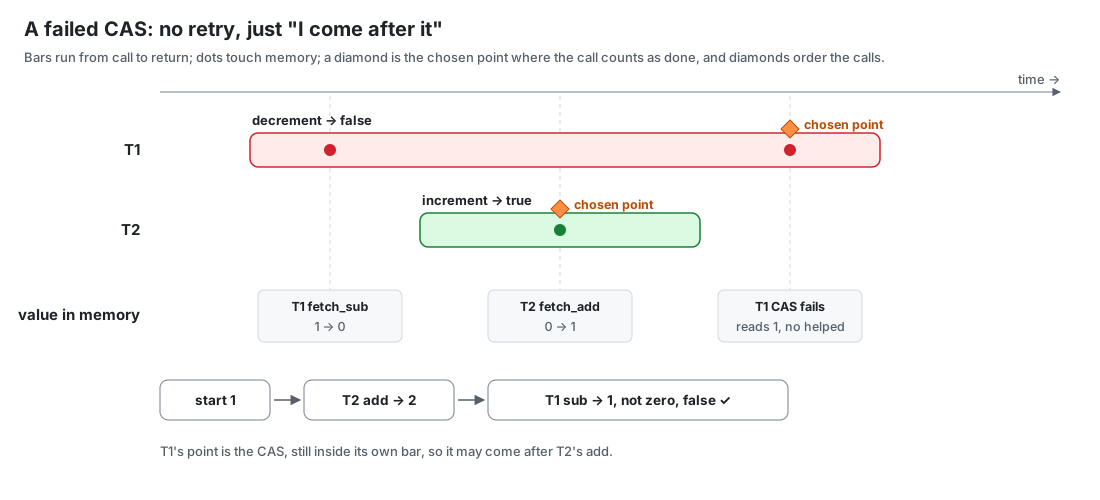
The lock-free version retries on conflict until its operation slots in cleanly. The wait-free version doesn’t retry; it explains the conflict instead. In the figure below, T1’s decrement() takes 1 to 0 with fetch_sub, and before it can pin the zero, T2’s increment() adds the 0 back to 1, so T1’s CAS fails. Put T1’s point at the CAS (still inside T1’s own span) and it comes after T2’s increment: 1 becomes 2, then 1 again, it didn’t reach zero, and returning false is consistent. A failed CAS no longer means “try again” but “I come after it”, so no loop is needed.
This explanation has limits: the return values of increment and decrement and “is it zero” can all be ordered this way, but a non-zero number returned by read() can’t always. The smallest example (initial count 1):
- T1
decrement:fetch_sub, 1 → 0. - T2
increment:fetch_add, 0 → 1; the old value has nois_zero, so the add counts. - T3
read: reads 1 and returns 1. - T2
decrement:fetch_sub, 1 → 0. - T1’s CAS changes 0 to
is_zeroand returnstrue. - T2’s CAS fails, the value has no
helped, and it returnsfalse.
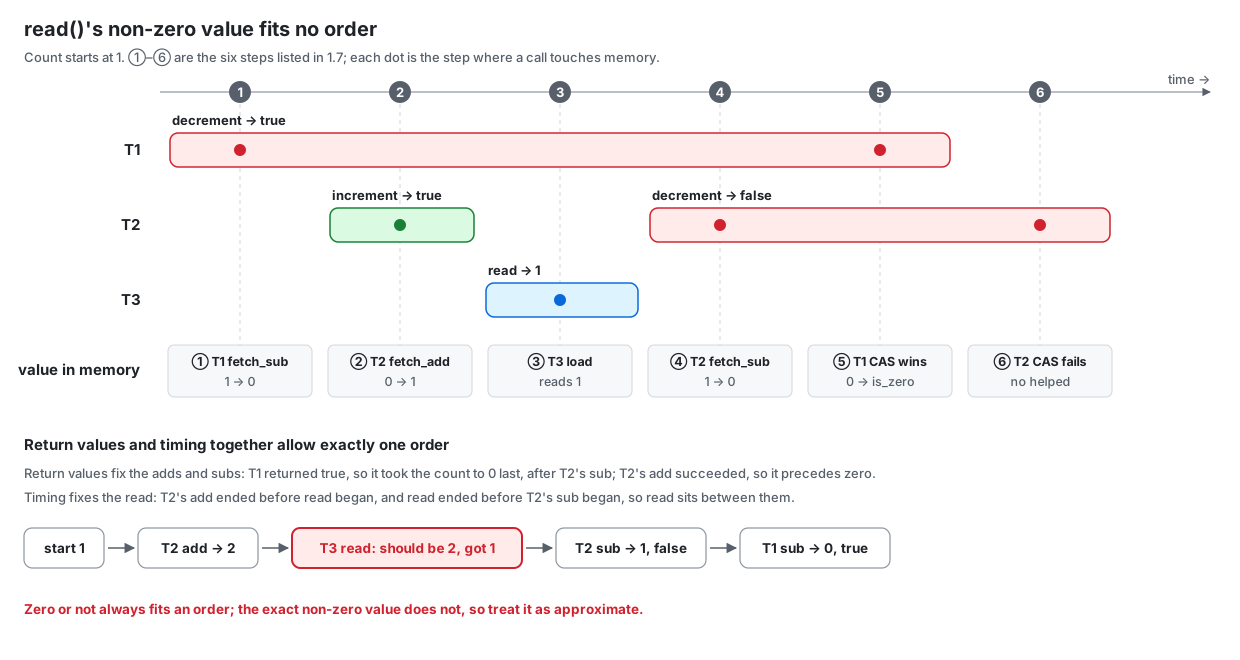
An order has to match both the return values and the timing. Start with the return values: T1 returned true, so it was the last to take the count to 0 and comes after T2’s decrement; T2’s increment succeeded, so it comes before the count reached zero. That leaves one order for the adds and subs: T2’s add, T2’s sub, T1’s sub. Then the timing: T2’s add finished before the read started, and the read finished before T2’s sub started, so the read has to sit between T2’s add and T2’s sub. The count there is 2, but the read returned the 1 in memory, and no order fixes that. Whether it is zero is reliable; the exact non-zero value is only an approximation, for the same reason shared_ptr::use_count() is only approximate with several threads.
1.8 Costs and Preconditions: A Bound Is Not Speed
What wait-free buys is a bound, not speed. With nobody competing, the lock-free version adds with one CAS and subtracts with one fetch_sub; the wait-free version needs one more CAS when it reaches zero, possibly an exchange on top, and the code is much harder to get right. So only low-level paths that are read-mostly, sensitive to P99 and P99.9, and must not be held back by other threads, such as reference counts, make it worthwhile; when writes are dense or the tail doesn’t matter, lock-free or a spinlock may do better.
Nor does it care how expensive each step is. When 8 cores hammer fetch_add on the same count, every step is a read-modify-write on the same line, and the line moves between cores (#16 1.4). The number of steps is bounded, but the time per step grows with contention. Wait-free removes retries, not cache line contention.
“No loop” also depends on the hardware. On x86, fetch_add, exchange and compare_exchange_strong are each a single lock-prefixed instruction that can’t fail and retry. ARM before the LSE (Large System Extensions) of ARMv8.1 has no single-instruction atomics of this kind, and the compiler turns them into “exclusive load, exclusive store, start over on failure” loops; strictly speaking that is only lock-free.
Memory order: whether the count itself is right (exactly one true) depends only on the atomicity of RMWs; RMWs on one word line up in a single order whatever their memory order. Memory order protects what lies outside the count, the object itself, and the code asks for ordering in only two places:
- The decrement uses release: my reads and writes of the object before I let go must be visible before this decrement is, or my write could land after the object has been destroyed.
- A successful claim (returning
true) is followed by an acquire fence: destruction anddeletecannot move ahead of it, and they see every holder’s accesses from before it let go. The fence is only on thetruepath, so no other thread pays for it.
Everything else (the increment, pinning, read()) uses relaxed: none of them touch the object afterwards, so there is nothing to pass on. Boost and libc++’s shared_ptr also use relaxed to add a reference.
Two details. The acquire goes after the read that decides the claim, not right after fetch_sub. Inside the window the count can be added back, the object used, and the count taken to 0 again: in the 1.7 example T1 claims at step 5 and has to see what T2 wrote while holding the object, and what links T1 to T2’s release decrement at step 4 is the value T1’s CAS reads, not the 1 its fetch_sub read. The relaxed pinning CAS and exchange don’t break that link either: after a release write, every RMW on the same variable, whatever its memory order, extends that write’s release sequence. Every modification of this counter is an RMW, so a claimer that reads the final value synchronizes with every earlier release decrement.
On x86 none of this costs an instruction: a lock-prefixed RMW is already a full barrier and the acquire fence only constrains the compiler, so acq_rel everywhere and the weakest orders compile to the same machine code. The difference shows on ARM: ldaddal becomes ldaddl, and only the claimer adds a dmb ishld.
1.9 When You Can’t Proceed: Spin, Yield, Sleep, or Return a Failure
When an operation can’t proceed (the lock is taken, the queue is full), a thread has four choices; #16 covered the first three:
- Spin: wait in place. Fastest when the thread is pinned to its own core and the wait is shorter than a sleep (2–10 µs).
- Yield (
sched_yield): give the CPU to another thread on the same core. A pinned, isolated core has no other thread, so this is spinning plus a system call; it is hardly ever used. - Sleep (futex, condition variable): for long waits, unpinned threads, or when CPU has to be saved; the cost is microseconds to wake up.
- Return a failure: don’t wait; tell the caller “can’t do it now” and let the caller decide whether to drop it, count it, take another path, or try again later.
A wait-free interface takes the fourth way. The SPSC ring in #4 is an example: try_claim() returns nullptr when the ring is full, a few loads and stores with no loop, and is wait-free; claim() spins in a loop until the consumer makes room, never returning if the consumer doesn’t move, and is blocking. Whether a ring is wait-free depends on the interface for when it is full, not on the ring itself. A ring where several producers grab slots with CAS has to retry when it loses, and is lock-free. A trading system’s hot path usually chooses to return a failure: if market data arrives faster than it can be handled, drop the old data and count it, rather than let the hot path be held back by someone else.