
A strategy thread hands persistence requests to an archiving thread, several strategy threads hand orders to one gateway thread, a market-data thread hands updates to several strategies: almost every thread in a trading system is connected to the next by a queue. The SPSC ring in #4 needs no lock because each index has exactly one writer: the producer only changes the write index and the consumer only changes the read index. In the three cases above, some threads should sleep when they have nothing to do and some queues have several producers, and that premise no longer holds. What follows starts from the plainest version, one mutex, works up to a multi-producer lock-free ring, and ends with what to do when a queue is full.
1. A Blocking Queue with a Mutex
1.1 The Structure: One Mutex, Two Condition Variables
Start with the first case: the archiving thread has nothing to do most of the time, and its queue is empty. If it spins while it waits (#16), it ties up a whole core for nothing; what it wants is to sleep when there is nothing to do and be woken when something arrives. With a capacity limit the reverse holds too: when the queue is full the producer sleeps, and it is woken when a slot frees up.
template <class T>
class BlockingQueue {
public:
    explicit BlockingQueue(std::size_t cap) : cap_(cap) {}

    bool push(T v) {                       // sleeps while full; returns false once closed
        std::unique_lock lk(m_);
        not_full_.wait(lk, [&] { return q_.size() < cap_ || closed_; });
        if (closed_) return false;
        q_.push_back(std::move(v));
        lk.unlock();                       // unlock before notifying, so the woken thread doesn't wait for the lock again
        not_empty_.notify_one();
        return true;
    }

    std::optional<T> pop() {               // sleeps while empty; returns nullopt once closed and drained
        std::unique_lock lk(m_);
        not_empty_.wait(lk, [&] { return !q_.empty() || closed_; });
        if (q_.empty()) return std::nullopt;
        T v = std::move(q_.front());
        q_.pop_front();
        lk.unlock();
        not_full_.notify_one();
        return v;
    }

    void close() {
        {
            std::lock_guard lk(m_);
            closed_ = true;
        }
        not_empty_.notify_all();           // wake every sleeper so it sees closed_
        not_full_.notify_all();
    }

private:
    std::mutex m_;
    std::condition_variable not_empty_;    // consumers wait here for "has data"
    std::condition_variable not_full_;     // producers wait here for "has room"
    std::deque<T> q_;
    const std::size_t cap_;
    bool closed_ = false;
};
One mutex m_ protects q_ and closed_, and every read and write of them happens under it. A condition variable is the tool that lets a thread sleep until a condition holds: wait puts the thread to sleep on it, and another thread wakes one sleeper with notify_one or all of them with notify_all.
There are two condition variables here, one per kind of wait: consumers wait on not_empty_ for data, producers wait on not_full_ for room. They are separate so that a notify wakes the right thread. A producer that adds an element should wake a consumer; if everyone slept on one condition variable, notify_one could wake another producer, which would find the queue still full and go back to sleep, while the consumer that should have woken stays asleep.
Both push and pop release the lock before notifying. Notifying under the lock is also correct, but the first thing the woken thread does is reacquire the lock, which the notifier still holds, so it immediately waits again. Unlocking before notifying only saves that short wait, and it relies on the condition having been changed under the lock; 1.3 shows why that premise matters.
1.2 Condition Variables: You Wait for a Condition, Not a Notification
not_empty_.wait(lk, pred) is the same as this loop:
while (!pred())
    not_empty_.wait(lk);   // unlocking and sleeping are one step; on waking it relocks, then returns
After waking, the condition has to be checked again, for two reasons:
- Spurious wakeups: the standard allows
waitto return when nobody notified, for example when the underlying futex wait is interrupted by a signal. The queue may still be empty. - Someone else got there first: a producer adds an element and
notify_onewakes sleeping consumer A. A has to reacquire the lock before returning, and in the meantime consumer B, which just arrived and never slept, takes the lock first, sees a non-empty queue, and takes the element. By the time A has the lock, the queue is empty again.
Written as if (q_.empty()) not_empty_.wait(lk);, both cases leave A calling front() on an empty deque, which is undefined behavior.
A condition variable stores no state: a notify sent while nobody waits is simply gone. Whether there is data is recorded in q_, under the lock; the condition variable only carries one message: the condition may have changed, go and look again.
1.3 Lost Wakeups: Changing the Condition and Notifying Must Be Separated by the Mutex
wait can be relied on because of one atomicity: from checking the condition until falling asleep the consumer holds the lock, and “unlock” and “sleep” are a single step. That only helps if the producer changes the condition while holding the same lock. Then the producer either changes it before the consumer checks (the consumer sees it and doesn’t sleep), or gets the lock only after the consumer is asleep (and the notify that follows is sure to wake it).
If the producer changes the condition without taking that lock, wakeups get lost. The usual way to get this wrong is adding a blocking wait to a lock-free ring: the producer publishes a sequence number with an atomic only, without the lock, then notifies; the consumer checks the sequence under the lock and sleeps if it is too low. The code below is that broken version:
// producer (wrong: changes cursor without holding m)
cursor.store(seq, std::memory_order_release);
cv.notify_all();

// consumer
std::unique_lock lk(m);
cv.wait(lk, [&] { return cursor.load(std::memory_order_acquire) >= seq; });
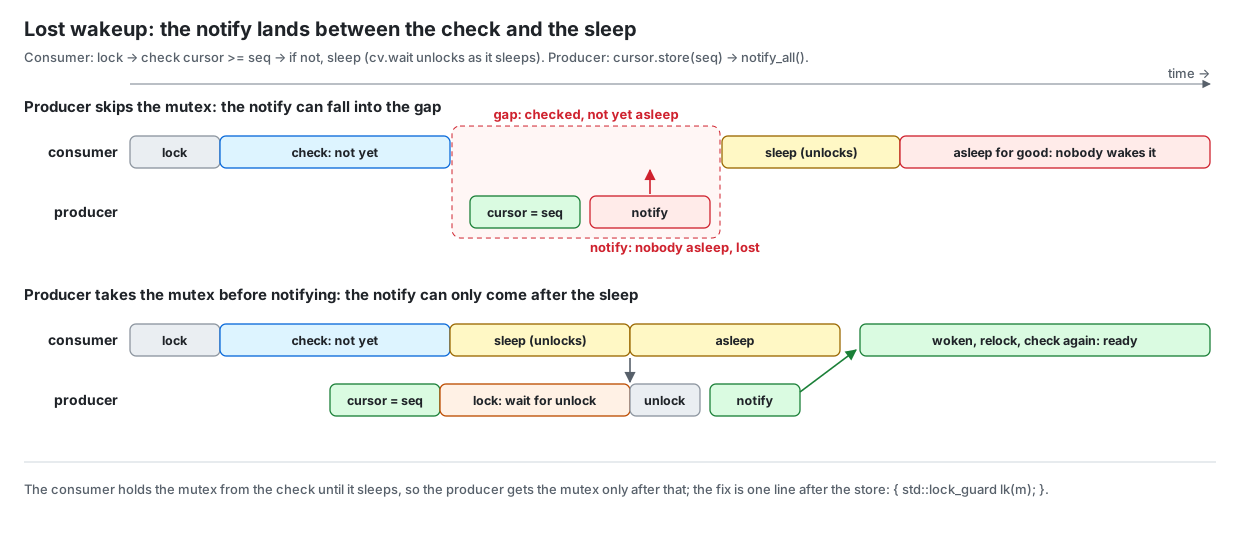
Top half: after the consumer has checked but before it sleeps, the producer changes cursor and notifies right away. Nobody is asleep, so the notify is lost. The consumer then goes to sleep, no further notify comes, and it sleeps on although the data arrived long ago. The fix is for the producer to take the lock once before notifying:
cursor.store(seq, std::memory_order_release);
{ std::lock_guard lk(m); }   // the consumer has either not checked yet (and will see the new cursor) or is already asleep
cv.notify_all();
Bottom half: the consumer holds the lock from the check until it sleeps, so the producer’s lock has to wait until it is asleep, and the notify always lands after that. Whenever the condition is not changed under the mutex, take the mutex once before notifying.
1.4 Closing: Letting Sleeping Threads Out
On shutdown the program has to join the consumer threads, but they may be asleep in pop; with no more data coming they never wake, and the join hangs with them. So the queue must be closable: close() sets closed_ under the lock and wakes every thread sleeping on either condition variable, and both wait conditions include closed_, so a thread that wakes and sees it stops waiting.
After closing, push returns false. pop first drains what is left and returns nullopt only once the queue is empty, so nothing already in the queue is lost by closing it. This needs notify_all, because every sleeping thread has to wake up and see closed_.
1.5 Cost: Tens of Nanoseconds Without Sleeping, Microseconds With
- No contention, no sleeping: one
pushis a lock and an unlock, two atomic read-modify-writes, plus thedequework, about 20–50 ns. - Contention: the cache line holding the lock moves between cores, as in #16; each operation pays one extra cross-core transfer (about 20–100 ns), and the more cores contend, the slower it gets.
- Sleeping: going to sleep on a futex and being woken, from the notify until the other thread actually runs, takes about 2–10 µs (Reference 2.1).
So a blocking queue wins on CPU use and on being easy to get right, not on speed. It suits paths that can afford a few microseconds, such as persistence, reconciliation and admin commands; hot paths like market data to strategy use lock-free rings with busy waiting (#4, #5), on pinned threads that never sleep.
2. Lock-Free Rings for Multiple Producers: rte_ring and Disruptor
2.1 rte_ring: Claim a Slot First, Then Publish in Order
When several strategy threads send orders to one gateway thread (multi-producer, single-consumer, MPSC), the write index has several writers and has to be claimed with CAS. After claiming a slot the producer still has to write the data, so there is a gap between “claimed” and “written”, and the consumer must not read a slot that has been claimed but not yet written. rte_ring (DPDK’s lock-free ring) handles this with two indices per side:
prod_head_: how far producers have claimed; producers compete for it with CAS;prod_tail_: how far producers have finished writing, i.e. how far consumers may read;- the consumer side mirrors it:
cons_head_is how far consumers have claimed,cons_tail_how far they have finished reading, i.e. how far producers may overwrite.
rte_ring itself is multi-producer, multi-consumer (MPMC), and the code below is the full MPMC version, with the consumer side written for several consumers. With a single consumer, cons_head_ is at most 1 ahead of cons_tail_ (the extra one is the slot it is reading right now), and only that consumer cares about the difference; the end of 2.2 shows how that simplifies.
template <class T, uint32_t N>             // N is a power of two
class MpmcRing {
    static_assert((N & (N - 1)) == 0);
public:
    explicit MpmcRing(uint32_t start = 0)  // adjustable start, for testing index wraparound
        : prod_head_(start), prod_tail_(start), cons_head_(start), cons_tail_(start) {}

    bool try_push(const T& v) {
        uint32_t head = prod_head_.load(std::memory_order_relaxed);
        do {
            if (head - cons_tail_.load(std::memory_order_acquire) == N)
                return false;                                        // full
        } while (!prod_head_.compare_exchange_weak(head, head + 1,   // ① claim a slot
                                                   std::memory_order_relaxed));
        buf_[head & (N - 1)] = v;                                    // ② write the claimed slot
        while (prod_tail_.load(std::memory_order_acquire) != head)   // ③ wait for earlier producers to publish
            _mm_pause();
        prod_tail_.store(head + 1, std::memory_order_release);       // ④ publish in order
        return true;
    }

    bool try_pop(T& out) {
        uint32_t head = cons_head_.load(std::memory_order_relaxed);
        do {
            if (head == prod_tail_.load(std::memory_order_acquire))
                return false;                                        // empty
        } while (!cons_head_.compare_exchange_weak(head, head + 1,
                                                   std::memory_order_relaxed));
        out = buf_[head & (N - 1)];
        while (cons_tail_.load(std::memory_order_acquire) != head)
            _mm_pause();
        cons_tail_.store(head + 1, std::memory_order_release);       // this slot can go back to producers
        return true;
    }

private:
    alignas(64) std::atomic<uint32_t> prod_head_{0};   // how far producers have claimed
    alignas(64) std::atomic<uint32_t> prod_tail_{0};   // how far producers have written, i.e. consumers may read
    alignas(64) std::atomic<uint32_t> cons_head_{0};   // how far consumers have claimed
    alignas(64) std::atomic<uint32_t> cons_tail_{0};   // how far consumers have read, i.e. producers may overwrite
    alignas(64) T buf_[N];
};
try_push has four steps:
- Read
prod_head_, check for full withhead - cons_tail_ == N, then CAS it fromheadtohead + 1. A failed CAS means another producer got there first;headnow holds the latest value, and the loop checks for full again. - Write the data into the claimed slot.
- Wait until
prod_tail_reacheshead, i.e. until every earlier producer has published. - Set
prod_tail_tohead + 1(release); from this moment consumers can read the slot.
The indices are uint32_t and only ever increase; they are stored unmasked and masked with & (N - 1) only when used. Empty is head == tail, full is head - tail == N. If the masked value were stored back, the indices could only range over 0 to N − 1, and empty and full would both look like two equal indices, with no way to tell them apart (#4 1.1).
When an index reaches $2^{32} - 1$ and is incremented, it wraps to 0, and the checks still work. Unsigned subtraction is modulo $2^{32}$, so as long as the real difference is at most N, head - tail gives the real difference. N is a power of two and divides $2^{32}$, so the slots also line up across the wrap: $2^{32} - 1$ lands in slot N − 1 and the next index, 0, lands in slot 0. With indices that only increase and a power-of-two N, wraparound needs no special handling. The test below starts the indices at $2^{32} - 1001$, so they wrap past 0 during the run, and the results are still correct.
2.2 Publishing in Order: One Number Can Only Say “Everything Before Is Done”
The wait in step ③ is the heart of this design. prod_tail_ is just one number, and consumers read it as “every slot below here has been written”. Say A claims 5 and B claims 6, and B finishes writing first. If B set prod_tail_ to 7 straight away, a consumer would go and read 5, which A hasn’t written yet. So B has to wait until prod_tail_ becomes 6 (A has published) before setting it to 7: publishing has to happen in the same order as claiming.
The load in step ③ has to be acquire. A publishes prod_tail_ = 6 with a release store and B reads 6 with acquire, so A’s write into slot 5 happens before B’s release store. A consumer that reads 7 with acquire then sees the data in both slot 5 and slot 6.
The price: if A is descheduled between ① and ④, B, C and everyone after them spin at ③ until A comes back. This is the same problem as the ticket lock in #16 2.1, where the thread whose turn it is gets descheduled and the whole queue stops. So strictly speaking this is not lock-free: one stalled producer can stall every other producer. DPDK can get away with it because its threads are pinned to dedicated cores and never descheduled; with ordinary, preemptible threads, the worst case for this ring is a stall of several milliseconds.
The consumer side is fully symmetric: consumers claim from cons_head_ with CAS, advance cons_tail_ in order once they have read, and producers check cons_tail_ to see whether they may overwrite. With a single consumer, as for the order gateway (MPSC), nobody competes with it and nobody ahead of it needs waiting for, so the CAS and a step-③-style wait both go away: after reading it simply stores cons_tail_ with release, and the two indices collapse into one. rte_ring’s single-consumer mode does exactly this.
2.3 Disruptor: Every Slot Marks Itself “Written”
The Disruptor is the ring buffer LMAX (a foreign-exchange trading venue) built for its matching engine. It is a separate design from rte_ring, and the code below is a separate class too (a trimmed C++ sketch of the idea, with multiple producers and one consumer). It keeps track differently, so that producers never wait for each other:
- Sequence numbers instead of indices: 64-bit signed sequence numbers that only increase and in practice never run out; a slot’s position is
seq & (N - 1). - Claiming with
fetch_add: each producer gets its number with onefetch_add(1), which cannot fail and never retries. It still has to wait when the ring is full; see 2.4. - An availability flag per slot: when a producer has written its slot, it writes the lap (
seq / N) into that slot’s flag, regardless of whether earlier numbers are done.
template <class T, int64_t N>              // N is a power of two
class MultiProducerRing {
    static_assert(N > 0 && (N & (N - 1)) == 0);
public:
    MultiProducerRing() {
        for (auto& a : avail_) a.store(-1, std::memory_order_relaxed);
    }

    // ---- producers, any number of them ----
    int64_t claim() {
        int64_t seq = claim_.fetch_add(1, std::memory_order_relaxed);  // claim a number: one step, no retry
        while (seq - N > consumed_.load(std::memory_order_acquire))   // full: wait until the consumer has read seq - N
            _mm_pause();
        return seq;
    }
    T& slot(int64_t seq) { return buf_[seq & (N - 1)]; }
    void publish(int64_t seq) {                                       // mark only this slot, wait for no one
        avail_[seq & (N - 1)].store(seq / N, std::memory_order_release);
    }

    // ---- the single consumer ----
    bool try_consume(T& out) {
        const int64_t seq = next_;
        if (avail_[seq & (N - 1)].load(std::memory_order_acquire) != seq / N)
            return false;                                             // this slot isn't written yet (for this lap)
        out = buf_[seq & (N - 1)];
        consumed_.store(seq, std::memory_order_release);              // seq has been read and may be overwritten
        next_ = seq + 1;
        return true;
    }

private:
    alignas(64) std::atomic<int64_t> claim_{0};       // next number to hand out
    alignas(64) std::atomic<int64_t> consumed_{-1};   // last number the consumer has read
    alignas(64) int64_t next_ = 0;                    // next number the consumer will read
    std::array<std::atomic<int64_t>, N> avail_;       // the lap each slot was last written in
    alignas(64) T buf_[N];
};
A producer writes one element in three steps: claim() for a number, write into slot(seq), then publish(seq). The consumer reads forward from next_, and before each slot it checks whether the flag equals next_ / N: if so it reads, if not it stops there and tries again later. The flag holds the lap rather than true because each slot is reused every N numbers, and a true left over from the previous lap would look the same as this lap’s; the lap number is different every time round.
Compare with rte_ring: A claims 5, B claims 6, B finishes first, calls publish(6) and returns. The consumer reaches 5, sees the flag isn’t set, and stops. When A finishes and calls publish(5), the consumer goes on to read 5 and 6. Delivering in order means a gap can’t be avoided; the two designs differ only in who waits: rte_ring makes the later producers spin, Disruptor makes the consumer stop at the gap while the other producers keep writing until the ring is full. If A stays stalled, neither design can deliver anything past 5; Disruptor just stops tying up the other producers’ threads as well.
2.4 Backpressure and Wait Strategies: When Full, Wait for the Slowest Consumer; When Empty, Choose How to Wait
When full. A producer holding number seq is about to write a slot whose previous occupant was seq - N; it may only overwrite once the consumer has read seq - N, so claim() waits until consumed_ >= seq - N. A slow consumer slows the producer down and no data is lost; this is called backpressure.
With several consumers, the Disruptor has every consumer read every event (a broadcast), each tracking its own sequence; producers wait for the slowest one, which the Disruptor calls the gating sequence, the minimum over all consumers’ sequences. Consumers can also depend on each other: C only reads sequences that both A and B have finished, i.e. the minimum of the two. A common diamond is: producer → journaling and replication → business logic.
When empty. The Disruptor has four wait strategies, which are exactly the four choices in #17 1.9:
- BusySpin: spin with
_mm_pause; - Yielding: spin 100 times, then
yield; - Sleeping: spin, then yield, then
sleep_for; - Blocking: a mutex and a condition variable.
Blocking is exactly the situation in 1.3: the sequence is an atomic that isn’t changed under the mutex, so the producer has to take the mutex once before notifying. A throughput test with one producer pouring data in shows the four strategies almost identical (about 30 ms for 5 million events each), because the consumer hardly ever waits; wait strategies differ in the latency of the first event after an idle period, which a throughput test can’t measure.
3. When the Queue Is Full: Block, Drop, or Overwrite
A bounded queue that is full has only three options:
| Option | Producer | Data | Where it’s used |
|---|---|---|---|
| Block (backpressure) | waits, slowed by the consumer | nothing lost | orders, fills, logs that must reach disk |
| Fail and drop | doesn’t wait, learns at once that it failed | the new element is dropped | market data: count the drops, rebuild the book from a snapshot |
| Overwrite | doesn’t wait, doesn’t know who hasn’t read | slow readers lose old data | one-to-many broadcast where only the latest state matters (the SPMC ring in #5) |
Which one to pick depends on whether losing an element or slowing the producer costs more. Orders can’t be lost, but a hot thread shouldn’t wait without bound either: the usual approach is that a failed try rejects the order and reports it to risk and the strategy, rather than silently blocking or silently dropping.