
An exchange’s Level-2 feed arrives on one callback thread: trades and order updates, tens of thousands a second when the market is busy. There is more than one consumer downstream — one writes every message to disk, one republishes over MQTT, one runs live analytics — and each of them must receive every message.
How do you hand one message to three readers? The first idea is the SPSC queue from #4: three of them, with the producer writing every message three times. An SPSC producer reads the consumer’s position to know whether the queue is full, and that read pays for itself: the producer never overwrites data a reader hasn’t read, and if it does drop something, it knows on the spot whose message it dropped. The cost is that once any reader falls behind and its queue fills, the producer has to choose right there: drop, or wait. Here the producer is the market-data hot path. It can never wait for any reader.
This post walks through a roughly fifty-line answer: an SPMC broadcast ring. Its trade is that the producer doesn’t look at the readers at all and simply overwrites the oldest slot once the ring is full. The idea fits in one sentence — move the “this message is published” signal out of a shared index and into each slot — but its consequences take a while to work through. Part 1 is the ring itself, what it does not guarantee, how readers still make the producer pay, and when not to use it; Part 2 is what changes when it moves into memory shared between processes.
1. The Broadcast Ring: One Producer, Many Readers
1.1 The Structure: A Ring of Stamped Slots
The design is a compact open-source ring (MengRao’s SPMC_Queue); the whole thing is about fifty lines:
#include <atomic>
#include <cstdint>

template<class T, uint32_t CNT>
class SPMCQueue {
public:
    static_assert(CNT && !(CNT & (CNT - 1)), "CNT must be a power of 2");

    struct Reader {
        operator bool() const { return q; }
        T* read() {
            auto& blk = q->blks[next_idx % CNT];
            uint32_t new_idx = ((std::atomic<uint32_t>*)&blk.idx)->load(std::memory_order_acquire);
            if (int(new_idx - next_idx) < 0) return nullptr;   // nothing new yet
            next_idx = new_idx + 1;
            return &blk.data;
        }
        T* readLast() {                                         // drain, keep only the newest
            T* ret = nullptr;
            while (T* cur = read()) ret = cur;
            return ret;
        }
        SPMCQueue<T, CNT>* q = nullptr;
        uint32_t next_idx;                                      // private to this reader
    };

    Reader getReader() {                                        // starts at the *next* message
        Reader reader;
        reader.q = this;
        reader.next_idx = write_idx + 1;
        return reader;
    }

    template<typename Writer>
    void write(Writer writer) {
        auto& blk = blks[++write_idx % CNT];
        writer(blk.data);                                       // fill the slot in place
        ((std::atomic<uint32_t>*)&blk.idx)->store(write_idx, std::memory_order_release);  // then stamp it
    }

private:
    struct alignas(64) Block {
        uint32_t idx = 0;                                       // which message this slot holds
        T data;
    } blks[CNT];
    alignas(128) uint32_t write_idx = 0;
};
Three things to notice before reading any function:
- The stamp
idxlives in every slot. Each block records which message number it currently holds. The publication signal is no longer one shared index that everyone reads; it travels with the data. write_idxis a plainuint32_t, not an atomic. Only the producer writes it;getReader()reads it once when a reader is created.CNTis a power of two, so% CNTcompiles to a mask (the trick from #4). The stamps are 32-bit and wrap after about 4.29 billion messages; the comparison inread()is written for that.
With the Level-2 trade record from the deployment this ring was built for — 88 bytes — a Block is 4 bytes of stamp, 4 of padding and 88 of data = 96, rounded up by alignas(64) to 128 bytes, exactly two cache lines. With CNT = 524288, one queue is 64 MiB.
Keeping the stamp next to the data also saves a round trip: a block’s first cache line holds the stamp plus the first 56 bytes of data. When a reader pulls that line over to check the stamp, those 56 bytes come with it and any field inside them is ready to use. With the stamp kept somewhere else, the reader would fetch the stamp’s line, check it, and only then fetch the data’s line — one more round trip to wait for.
The alignas(64) keeps neighbouring slots on different lines, so the producer writing slot i doesn’t drag a line a reader is using for slot i − 1 (false sharing, #2). Aligning write_idx to 128 rather than 64 is commonly explained by CPUs that prefetch cache lines in adjacent pairs; the design doesn’t say, so treat that as the likely reason rather than a stated one.
1.2 The Producer: Write, Then Stamp
auto& blk = blks[++write_idx % CNT];
writer(blk.data);                                                                  // ① the caller's lambda fills the slot
((std::atomic<uint32_t>*)&blk.idx)->store(write_idx, std::memory_order_release); // ② then the slot gets its new number
It’s the two-step hand-off from #4 — write in place, then publish — except that publishing now means stamping this slot instead of advancing a shared index.
And the producer never reads anything a reader writes. There is no “full”: after one lap it simply overwrites the oldest slot. So it never waits, and the number of steps it takes doesn’t depend on how many readers exist or how slow they are.
1.3 The Reader: One Subtraction, Three Meanings
A Reader holds only a pointer to the queue and its own next_idx — “the message number I want next”. It lives in the reader’s own memory, and the reader never writes to the queue. Readers don’t contend with each other, and adding or removing one doesn’t change a single step of the producer’s code path.
read() looks at the slot where message next_idx would be, and compares that slot’s stamp new_idx with what it wants. A picture makes it obvious: at the same moment, three readers that are behind by different amounts see exactly the three cases.
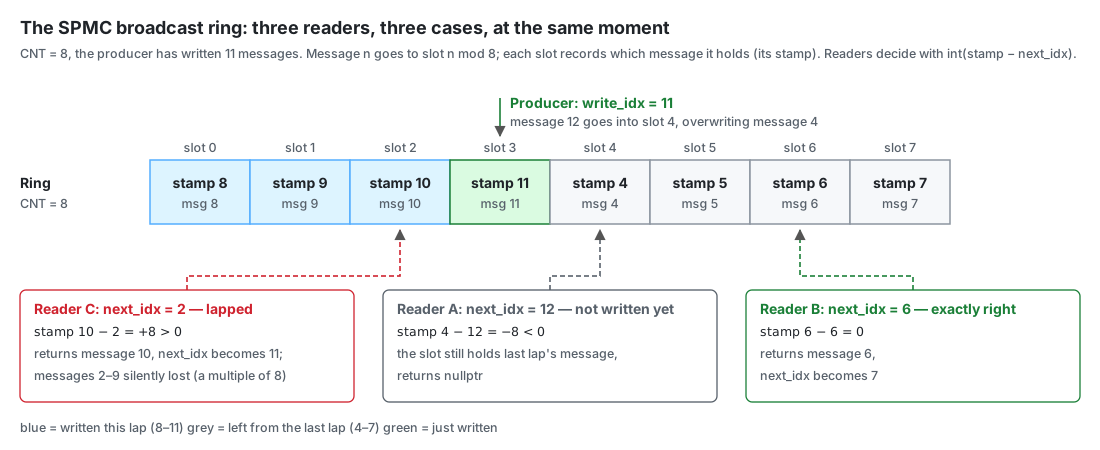
The same three cases as a rule:
int(new_idx - next_idx) | Meaning | What read() does |
|---|---|---|
| < 0 | The slot still holds last lap’s message; the producer hasn’t reached mine | returns nullptr |
| == 0 | Exactly the message I’m waiting for | returns it, next_idx = new_idx + 1 |
| > 0 | The producer lapped me; this slot already holds a newer message | returns the newer message, next_idx = new_idx + 1 — everything in between is skipped |
Two details carry most of the weight.
Why int(new_idx - next_idx) < 0 and not new_idx < next_idx. The stamps wrap at 2³². Subtracting as unsigned and reinterpreting the difference as signed gives the right order as long as the two are less than 2³¹ apart, across the wrap too. A direct comparison flips at the wrap: with next_idx = 0xFFFFFFFE and a new stamp of 1 after wrapping, the signed difference is +3 — new data, correct — while 1 < 0xFFFFFFFE claims “not written yet”.
A positive difference is always a multiple of CNT. A slot’s stamp is a message number and its position is that number mod CNT, so the stamp in the slot a reader looks at can only be next_idx, next_idx ± CNT, ± 2·CNT… Measured with CNT = 8: a reader holding next_idx = 6 while the producer was at 30 got message 30 first — a difference of 24 = 3 × 8.
The two other entry points follow from the same rule: getReader() starts at write_idx + 1, so it never replays history (a reader created after five messages gets nullptr, then message 6); readLast() drains until nullptr and keeps only the newest — for a consumer that only wants the latest snapshot.
1.4 Memory Order: The Stamp Is the Publication
The memory orders are the release/acquire pair from #2, moved into the slot: the producer fills the data with ordinary stores and then release-stores the stamp; the reader acquire-loads the stamp and only then reads the data. Once the reader sees the new stamp, it is guaranteed to see the data written before it. Because the signal is per slot, any number of readers decide independently, with no writable state shared among them.
1.5 What the Design Does Not Guarantee
The trade is now visible: the producer waits for nobody, so the readers absorb the consequences. There are two: overruns are silent (1.5.1), and a re-check can’t catch a half-write (1.5.2).
1.5.1 Overruns Are Silent
The first consequence is overrun. With CNT = 8, a reader that hasn’t read anything while the producer wrote 20 messages receives 17, 18, 19, 20. Messages 1–16 were never delivered — and the queue doesn’t say so. read() returns only a pointer and overwrites next_idx; the caller can’t tell from the return value that anything was skipped.
The information is right there: the positive difference is exactly the number of skipped messages. Making it visible is one line — have read() report it, or accumulate skipped += diff in the Reader. Otherwise you need a sequence number inside the message itself.
In production CNT = 524288, so a reader has to fall half a million messages behind before it’s lapped. But a reader that does slow work per message — formatting a string, a synchronous MQTT publish, an fprintf — moves toward that edge every time it’s slower than the feed.
1.5.2 A Re-Check That Can’t See a Half-Write
read() returns &blk.data, a pointer into the shared slot, and the reader then reads the fields one by one. If the producer comes around and rewrites that slot meanwhile, the reader sees a mixture of old and new fields: a torn read.
The obvious fix is to re-read the stamp after copying the data and discard the copy if it changed. It doesn’t work, and the reason is instructive. Stress test: CNT = 4, producer writing flat out, three seconds per case — deliberately the worst setting, to show the effect exists:
| Case | Accepted reads | Torn among them |
|---|---|---|
| As written: read through the pointer | 59,869,704 | 3,269,273 (≈ 5.5%) |
Re-read idx after copying, discard if changed | 43,942,557 (8,861,343 discarded) | 2,084,572 (≈ 4.7%) |
| Producer invalidates the stamp first, then writes, then stamps; reader re-checks | 38,607,078 (6,436,383 discarded) | 0 |
The second row is the lesson. This producer writes the data first and changes the stamp last. Halfway through a rewrite the stamp is still the old one, so the reader’s re-check sees “unchanged” and accepts a half-written record. The re-check only works if the producer destroys the old stamp before touching any data:
// producer: three steps instead of two
((std::atomic<uint32_t>*)&blk.idx)->store(0, std::memory_order_relaxed);         // ① invalidate the stamp
std::atomic_thread_fence(std::memory_order_release);
writer(blk.data);                                                                 // ② write the data
((std::atomic<uint32_t>*)&blk.idx)->store(write_idx, std::memory_order_release); // ③ stamp the new number
// reader: copy the data → atomic_thread_fence(acquire) → re-read idx;
//         anything other than the number seen before the copy means "discard this copy"
Now the reasoning closes: if the stamp is still the old one, not a byte of the data has been touched. Any overlap between the copy and a rewrite leaves the stamp either 0 (rewrite in progress) or the new number (rewrite done), and either way the copy is discarded. The two fences make “stamp changes before data changes” and “data is copied before the stamp is re-read” hold against both the compiler and the CPU. (Measured on x86; under the strict C++ memory model the data fields themselves would also need to be atomics.)
These are boundaries found under stress, not a claim that the original ring tears reads every day in production. A big ring and fast readers make it rare. Rare is not zero.
1.6 On Real Hardware, Do Readers Slow the Producer?
1.5 says the producer waits for nobody, and in the code that’s true: nothing in write() touches a reader. But the code runs on a CPU, and the readers run on its other cores. The feed is the hot path, so before attaching one more reader you want to know how much time it costs the producer in hardware. This section works that out.
The answer first: readers never make the producer wait, but a reader that keeps up adds one cross-core exchange to every write. In normal times the exchange finishes in the background and you can’t see it; it shows only when the producer writes flat out, where one reader takes a write from 3–13 ns to 15–23 ns (1.6.3). A reader that has fallen behind costs the producer nothing.
1.6.1 Why It Gets Slower
Caches work in lines of 64 bytes. Several cores can each hold a copy of the same line and all read it; but before a core may write a line, it has to tell the other cores to invalidate their copies and wait for their answers. That exchange is a cross-core round trip of about 20–100 ns (reference 2.1); the rules are those of MESI. If no other core holds a copy, there’s nobody to ask and the write goes straight through.
A reader that has read the newest message has nothing to do, so it keeps checking whether the next slot has been written. That is exactly the slot the producer writes next, so the reader always holds a copy of its line. To write the slot, the producer first has to have the reader invalidate its copy and wait for the answer; right after the write, the reader reads the line back and starts watching the slot after. Every message goes through this once; with several readers, there are several copies to invalidate.
The line the producer is about to write is always already in a reader’s hands, and the producer has to take it back before every write — that’s what “taking the line” means below.
1.6.2 Normal Times: You Can’t Tell
In normal times every message has its line taken once. Even a busy feed leaves tens of microseconds between messages, and a hot-path reader has long finished the last one and is back watching the next slot.
The producer doesn’t notice, because it doesn’t stop to wait for the answer: the write goes into a small queue inside the core (the store buffer), the core carries on, and write() returns at once; invalidating the copies, waiting for the answers and actually writing into the cache all happen in the background, in hardware. With tens of microseconds between messages, that background work is long done before the next write.
Measured: a 512 KiB ring, one write every 2 µs, readers reading the message contents. With 0 to 5 readers the median write() stayed at 10 ns, the smallest step the timer can resolve; only the slowest one in a thousand moved, from 20 to 70 ns. With the production-size 64 MiB ring and one write every 1 µs (a second program, where the timing itself costs 30 ns), 0 to 4 readers left the median at 30 ns, the same as with no reader.
1.6.3 Flat Out, Readers Keeping Up: Every Write Costs More
Right after the open, data comes in waves and the producer writes runs of messages back to back. Now the background can’t keep up: the small queue has only a few dozen entries, earlier writes are still waiting for answers while new ones keep coming, the queue fills, and the core has to stop and wait. Every write now pays the full exchange.
This experiment measures that case. The producer writes flat out; readers on other physical cores do nothing but read, and once caught up they watch the next slot (Ryzen 5 5600GT, Windows, median of three 1-second runs). Two rings: 512 KiB, which fits in cache, and 64 MiB, the production size, which doesn’t. Two kinds of reader: one that only checks the stamp, and one that also reads the contents of each message it gets.
ns per write() | 0 readers | 1 | 2 | 3 | 4 | 5 |
|---|---|---|---|---|---|---|
| 512 KiB ring, readers check the stamp only | 2.8 | 18.5 | 24.0 | 25.3 | 26.4 | 28.0 |
| 512 KiB ring, readers also read the contents | 2.8 | 22.8 | 25.8 | 28.5 | 32.5 | 37.0 |
| 64 MiB ring, readers check the stamp only | 12.6 | 15.3 | 17.4 | 19.9 | 22.5 | 26.0 |
| 64 MiB ring, readers also read the contents | 12.6 | 20.1 | 26.8 | 29.8 | 33.8 | 38.7 |
With no readers, only the producer touches these lines and it never has to ask another core. In the small ring the lines stay in the producer’s own cache: 2.8 ns a write. In the large ring, by the time the producer comes round again a line has been pushed out to memory and has to be fetched back: 12.6 ns a write.
The small ring climbs most steeply. The first reader alone takes it from 2.8 to 18.5 ns: from “nobody takes my lines” to “every write has to take its line back first”. More readers only mean the same notice goes to more cores and they answer together, so each extra reader adds 1–7 ns. In the large ring the line has to come from far away anyway — from memory with no reader, from a reader’s core with one — so the first reader adds less.
1.6.4 Flat Out, Readers Falling Behind: Nothing Taken
Real readers do work on every message and may not keep up with a flat-out producer, so they fall behind. A reader that has fallen behind reads slots the producer finished long ago; it never touches the line the producer is about to write, so there’s nothing to take.
A different program measured this: a 64 MiB ring, 20 million flat-out writes, three runs per case, average time per write (Ryzen 5 5600GT, Windows). It isn’t the program behind 1.6.3, so compare these numbers only with each other.
- no readers: 12.6–14.0 ns
- 1–4 readers that only read slots 4,096–8,191 behind the producer: 13.0–13.9 ns, the same as no readers
- 1–4 cores spinning on their own without touching the ring: 12.7–15.2 ns. A control: more busy cores don’t slow the producer by themselves
- 1 normal reader, watching the next slot once caught up: 25.6–35.4 ns; 2–4: 49.9–55.0 ns. Also a control: this program does see lines being taken
The slots it has already read don’t get in the way either: the producer writes there again only after coming all the way round, which takes 6–7 ms even flat out on a 64 MiB ring; by then the reader has read another 64 MiB, and its old copies are long gone from its cache. When the producer comes back, no other core holds the line and there’s nobody to ask. In a ring small enough for a reader’s cache to hold, old copies may still be there; that case wasn’t measured.
With nothing taken, the bill moves to the reader: messages queue in the ring until it gets to them. A reader k messages behind makes a new message wait until it has handled the k before it; a reader more than a lap behind gets overrun, and 2.3.2 works out the headroom.
1.6.5 How Should a Reader Wait?
read() returns at once when there’s nothing new; how to wait after that is up to each reader’s own loop.
A hot-path reader has to take every message the moment it lands, so it has to watch the next slot and pay: hidden in normal times, slower writes only when the producer runs flat out.
A reader that isn’t in a hurry — the disk writer, a monitor — shouldn’t watch the next slot; it should wake up every so often and read everything that piled up in one go. At 50,000 messages a second, waking every 1 ms means batches of 50, far inside the roughly 10-second overrun headroom from 2.3.2. Most of a batch is slots the producer finished long ago; only on reaching the newest slot does it touch the line the producer is about to write, so it takes a line once per batch, not once per message.
1.7 When Not to Use a Broadcast Ring
Back to the opening choice: several SPSC queues, or one broadcast ring. They differ in one thing — whether the producer looks at where the readers are.
Several SPSC queues means looking. What looking buys is that 1.5.1 and 1.5.2 can’t happen: the producer never overwrites a slot a reader hasn’t finished, so there are no silent overruns and no half-written reads; and each queue can carry only the part its reader needs. What it costs: the producer’s work grows with the number of readers, one copy per reader; when a reader falls far enough behind to fill its queue, the producer has to choose between waiting and dropping on the spot; and the set of readers has to be known up front, so attaching a new one means touching the producer.
A broadcast ring means not looking. One write, readers attach whenever they like, and the producer’s steps never change. The cost is all of 1.5 and 1.6: readers carry overruns and torn reads themselves, every reader has to go through the full stream, and readers watching the newest slot still make every write cost more when the producer runs flat out.
The table in 1.6.3 also lets you work out the hardware bills: from the second reader on, each extra reader adds only 1–7 ns. If every reader needs everything, N SPSC queues mean N copies of every message, each watched by its own reader and each needing its own invalidation, while the broadcast ring writes once and every reader after the first adds a few nanoseconds. If each reader needs only a part — stocks split across a few compute threads, say — every message goes into exactly one queue with one reader watching, so the producer’s cost stays at roughly the one-reader level, plus the check on that reader’s position, however many readers there are; and no reader has to skip over messages meant for others.
So: when readers all need the full stream, come and go, or live in other processes (disk, republishing, monitoring), use the broadcast ring; when readers each need a subset, or a drop must be known the moment it happens, use per-reader SPSC queues. The two combine: the feed thread writes every message into the broadcast ring for the readers that aren’t in a hurry, and also into the SPSC queue of the compute thread that owns that stock. Having a separate thread read the ring and redistribute instead puts one more cross-core handoff on the hot path.
2. Into Shared Memory
2.1 shmmap: Four Calls
In deployment the producer and the readers are separate processes. The ring goes into POSIX shared memory:
#include <fcntl.h>
#include <sys/mman.h>
#include <unistd.h>

template <class Q> Q* shmmap(const char* name) {
    int fd = shm_open(name, O_CREAT | O_RDWR, 0666);                          // ① open (or create) by name
    if (fd == -1) return nullptr;
    if (ftruncate(fd, sizeof(Q))) { close(fd); return nullptr; }              // ② size it to the queue
    Q* ret = (Q*)mmap(nullptr, sizeof(Q), PROT_READ | PROT_WRITE, MAP_SHARED, fd, 0);  // ③ map it
    close(fd);                                                                 // ④ the mapping survives
    return ret == MAP_FAILED ? nullptr : ret;
}
- Same name, same memory. On Linux the object lives under
/dev/shm(tmpfs, never on disk). Producer and readers all callshmmapwith the same name. - No constructor runs.
mmapreturns bytes that are merely viewed as aQ. The queue relies on fresh memory being zero —idx = 0andwrite_idx = 0is an empty queue — andftruncateguarantees the new range is zero-filled. - It outlives the processes until
shm_unlinkor reboot. - One queue, one writer.
++write_idxis a plain increment; two writers would trample each other. Each feed gets its own queue.
2.2 Same Bytes, Different Addresses
The rule that matters most comes from running it. Two processes mapped the same named region (measured with Windows’ equivalent, CreateFileMapping + MapViewOfFile):
[producer] view at 0000017987cc0000
[reader  ] view at 000001ae3be70000
[reader  ] m->self = 0000017987cc0048   vs my address of this block = 000001ae3be70048   (DIFFERENT)
All messages arrived, and the same physical memory sat at different virtual addresses in the two processes. A pointer stored inside the region — even a pointer to the region itself — is wrong on the other side. A pointer to a string literal happened to match because both processes were the same executable, loaded at the same base; different programs or address-space randomization break that. Don’t rely on it.
So elements in shared memory must be self-contained: integers, floats, fixed-size arrays. No pointers of any kind — not to the heap, not into the region, not to literals, and no vtable pointers, so no virtual functions. That’s why the security ID is char SecurityID[31] and not std::string, and std::string fails twice over: a long string’s bytes live on the writer’s heap, and a short one (small-string optimization) stores a pointer to its own internal buffer — measured with libstdc++, &s ended in …880 and s.data() in …890 — which points to the wrong place once the region is mapped elsewhere.
The same reasoning yields the other contracts both sides must share: one struct definition compiled the same way (change the layout and old shared objects no longer match — rename the region or shm_unlink it first); and alignas still holds, because mmap returns page-aligned addresses and the queue sits at the start.
2.3 Three Deployment Traps
2.3.1 The First Lap Pays Page Faults
Shared memory is allocated on demand: a 4 KiB page gets a physical page the first time it’s touched. A slot is 128 bytes, so every 32 writes step into a fresh page. Measured on a 64 MiB Windows mapping (Linux tmpfs works the same way; the numbers differ):
| Lap 1: mean / p99 | Lap 2: mean / p99 | |
|---|---|---|
| fresh mapping | 56.1 ns / 1,302 ns | 8.6 ns / 10 ns |
| one byte written to every 4 KiB page before starting | 9.0 ns / 10 ns | 8.8 ns / 10 ns |
That’s about 1.5 µs per fault ((56.1 − 9.0) × 32). Touch every page before the open and the first lap looks like the second — the same rule as for memory pools (#3): never let a first time happen on the hot path.
2.3.2 A Slow Reader Gets Lapped: Headroom = Capacity ÷ Rate Gap
If a reader spends longer per message than the producer’s interval, it falls behind steadily; once it is CNT messages behind, it’s lapped and drops data silently. Seconds of headroom = 524,288 ÷ (feed rate − processing rate); a reader that stops entirely has 524,288 ÷ feed rate — at 50,000 messages per second, about 10.5 seconds. Keep slow work out of the read() loop (hand it to another queue or thread) and monitor the lag, write_idx − next_idx.
2.3.3 A Restarted Reader Loses Everything Unless It Saved Its Cursor
getReader() starts at the next message, so a recorder that crashes at 10:00:00 and comes back at 10:00:03 silently skips three seconds — 150,000 messages at 50,000 per second. next_idx is public and private to the reader, so it can be persisted and restored. Measured with CNT = 8:
reader read 1..5, "crashed" with next_idx = 6; producer wrote 6..10
  rebuilt with getReader()       -> 10            (6..9 lost)
  resumed from saved next_idx    -> 6 7 8 9 10    (nothing lost)
saved cursor more than a lap behind (producer at 30)
  first read() returns 30, skipping 24 (= 3 laps); 23..29 were still in the ring but are never revisited
Resuming works as long as the reader is less than one lap behind; save the cursor outside the process, or it dies with it. The mirror-image trap: the queue is recreated (say, shm_unlink before each trading day) but an old reader keeps running. New stamps start at 0, the reader’s cursor is in the millions, int(new_idx - next_idx) < 0 holds forever, and read() returns nullptr — it looks like “no new messages” and is actually stuck until the new stamps catch up (measured: cursor 1000, nothing read while the new writer wrote 1..999). Restart readers with the queue, or detect stamps going backwards.