
A hot thread that has to hand work to another thread — a log line, a market-data tick, an order event — can’t reach for a mutex. Not because the lock instruction is slow (uncontended, it’s cheap), but because of what a contended lock can turn into: the loser goes to sleep in the kernel, and when it wakes up is the scheduler’s decision, not yours. If the thread holding the lock is a low-priority background worker, you’ve built a priority inversion into your own critical path. What you’re avoiding isn’t a number of nanoseconds; it’s a latency distribution with a long tail you don’t control.
So the goal isn’t “fast”, it’s “bounded”, and the tool is a lock-free queue. The whole design rests on one idea: every shared variable has exactly one writer — each side updates only its own counter and merely reads the other’s, so the two cores never fight over a write. Part 1 builds the ring and shows the first trap that quietly breaks that rule. Part 2 shrinks the cross-core traffic that remains. Part 3 builds a logger on top and finds that one log line can eat thirty slots. Part 4 asks what “lock-free” and “wait-free” actually promise, and Part 5 uses the queue for micro-batching. The surrounding hygiene is assumed: the hot thread is pinned and isolated (#1), the memory it touches is locked and pre-faulted (#3), and the cache-line mechanics of #2 — release/acquire pairing and the price of a contended line — show up on almost every line below.
1. The SPSC Ring
1.1 Two Counters and a Mask
A single-producer single-consumer (SPSC) queue is a fixed array of slots plus two counters. The producer owns write_idx — only it ever stores to it. The consumer owns read_idx. Each side reads the other’s counter to learn whether there’s room (producer) or data (consumer), but never writes it. That asymmetry is the whole design: with one writer per variable there is nothing to lock and nothing to retry.
template <typename T>
class SpscQueue {
  std::vector<T> slots_;                       // capacity is a power of two
  size_t         mask_;                        // capacity - 1

  alignas(64) std::atomic<size_t> write_idx_{0};   // stored to only by the producer
  alignas(64) std::atomic<size_t> read_idx_{0};    // stored to only by the consumer

 public:
  explicit SpscQueue(size_t n) : slots_(round_up_pow2(n)), mask_(slots_.size() - 1) {}

  // ---- producer ----
  T* try_claim() {                             // step 1: where do I write?  nullptr = full
    const size_t w = write_idx_.load(std::memory_order_relaxed);   // my own counter
    const size_t r = read_idx_.load(std::memory_order_acquire);    // theirs
    if (w - r == slots_.size()) return nullptr;
    return &slots_[w & mask_];
  }
  void publish() {                             // step 2: make the element visible
    write_idx_.store(write_idx_.load(std::memory_order_relaxed) + 1,
                     std::memory_order_release);
  }

  // ---- consumer ----
  T* try_peek() {                              // nullptr = empty
    const size_t r = read_idx_.load(std::memory_order_relaxed);    // mine
    const size_t w = write_idx_.load(std::memory_order_acquire);   // theirs
    if (r == w) return nullptr;
    return &slots_[r & mask_];
  }
  void release() {                             // done reading: hand the slot back
    read_idx_.store(read_idx_.load(std::memory_order_relaxed) + 1,
                    std::memory_order_release);
  }
};
Three details in there are worth slowing down for.
The mask. The counters only ever increase; a slot is idx & mask_, where mask_ = capacity - 1. That equals idx % capacity for every idx — but only when the capacity is a power of two, because then capacity - 1 is a run of ones and the AND simply keeps the low bits. Since the capacity is a runtime value, the compiler can’t turn % into a shift for you; the constructor rounds the requested size up to the next power of two (round_up_pow2 is the usual bit-smearing helper) so the hot path gets a one-cycle AND instead of a hardware divide.
Two steps, not one. Instead of push(const T&), the producer gets a pointer to the slot, constructs the element in place, and then publishes. The element is written once, straight into its final home; a push(const T&) would build it somewhere else and copy it in. Publishing is a separate step because it’s the only moment the consumer is allowed to notice the element exists.
Each side reads its own counter relaxed, the other’s acquire, and publishes its own with release. Only the owner ever writes a counter, so a relaxed read of your own is enough — a thread always sees its own earlier writes. The other side’s counter is the one that carries information across cores. The producer’s release store of write_idx_ guarantees the slot’s contents are visible to any consumer whose acquire load sees the new index; the consumer’s release store of read_idx_ guarantees it has finished reading a slot before a producer that observes that slot as free overwrites it. That’s the release/acquire pairing from post #2 doing real work. On x86 a release store compiles to an ordinary mov — the ordering is free; on ARM it’s a stlr, and it isn’t.
One precedence trap, if you write the full-check with wrapped (masked) indices instead of monotonic counters: (w + 1) & mask == r & mask does not mean what it looks like. == binds tighter than &, so it parses as (w + 1) & (mask == r) & mask, and the “is it full?” test is almost always false — the producer cheerfully overwrites unread data. Parenthesize both masked operands, or use unwrapped counters and compare w - r against the capacity, as above.
1.2 Subtract, Don’t Count: The Counter That Made Two Cores Fight
It’s tempting to add a third field: an atomic element count, incremented by the producer on publish and decremented by the consumer on release, so that size() is a single load.
std::atomic<size_t> count_{0};
// producer, after publishing:   count_.fetch_add(1, std::memory_order_release);
// consumer, after releasing:    count_.fetch_sub(1, std::memory_order_release);
That counter is the one variable both cores write. fetch_add and fetch_sub are read-modify-writes, and a read-modify-write needs the cache line in an exclusive state (Modified or Exclusive) — so every enqueue pulls the line away from the consumer and every dequeue pulls it back. It’s the ownership ping-pong from post #2, with one difference worth noticing: this is true sharing, not false sharing. Padding the counter onto its own cache line can’t help, because the two cores genuinely both want to modify the same variable.
The fix is to notice you already have the answer. The number of elements is write_idx - read_idx, and computing it takes two plain loads — and a load only needs the line in a shared state, with no ownership transfer:
size_t size_approx() const {
  const size_t r = read_idx_.load(std::memory_order_acquire);    // the lagging counter first…
  const size_t w = write_idx_.load(std::memory_order_acquire);   // …then the leading one
  return w - r;
}
Two properties to keep. It’s a snapshot pair, not an instant. The two loads happen at slightly different moments, so the result is approximate — fine for “roughly how backed up are we”, wrong for a decision that needs an exact answer. Reading the lagging counter first makes it an over-estimate: it can never come out negative, but if both sides advance a long way between the two loads it can even read above the capacity, so clamp it if that matters. The read order matters for an outside observer. w >= r holds at every instant; reading r first guarantees the w you see is no older than that moment, so the difference can’t come out negative. (The acquire on the first load is also what keeps the second load from being reordered ahead of it; with two relaxed loads the order would only be a suggestion.) Read them the other way around and a third thread — a monitoring loop, say — can pick up a w from before both sides moved and an r from after: w - r goes negative, which with unsigned counters wraps to an enormous number. (The producer or consumer calling size_approx() on itself can’t hit this, because its own counter can’t move in the middle of its own call. The rule exists for the public size() that any thread may call.)
2. Cutting the Remaining Cross-Core Traffic
2.1 Cache Their Cursor: A Stale Value That Can Only Err Safe
Look at what try_claim() does on every call: an acquire load of read_idx_ — a counter the consumer writes. If the queue is nearly empty and nowhere near full, that read is wasted, but it isn’t free: each time the consumer advances its counter, the producer’s next read has to fetch the updated line across cores. The consumer’s try_peek() has the mirror-image problem with write_idx_.
The fix is the locally cached copy that post #2 previewed for exactly this situation, now inside a real queue: the producer keeps a private cached_read_idx_, checks against that, and only when the cache says “full” pays for one real cross-core load, refreshes the cache, and checks again.
alignas(64) std::atomic<size_t> write_idx_{0};
            size_t              cached_read_idx_ = 0;    // producer-private: rides on the producer's own line
alignas(64) std::atomic<size_t> read_idx_{0};
            size_t              cached_write_idx_ = 0;   // consumer-private

T* try_claim() {
  const size_t w = write_idx_.load(std::memory_order_relaxed);
  if (w - cached_read_idx_ == slots_.size()) {                       // looks full — the cache may be stale
    cached_read_idx_ = read_idx_.load(std::memory_order_acquire);    // pay for one cross-core read
    if (w - cached_read_idx_ == slots_.size()) return nullptr;       // really full
  }
  return &slots_[w & mask_];
}

T* try_peek() {
  const size_t r = read_idx_.load(std::memory_order_relaxed);
  if (r == cached_write_idx_) {                                      // looks empty — refresh
    cached_write_idx_ = write_idx_.load(std::memory_order_acquire);
    if (r == cached_write_idx_) return nullptr;                      // really empty
  }
  return &slots_[r & mask_];
}
Why a stale cache is safe. The consumer’s counter only ever moves forward, so the producer’s cached copy is always at most the real value — never ahead of it. Free space is computed from capacity - (w - cached_read_idx_), so a stale cache can only under-estimate the room. It can say “full” when there’s actually space — in which case the code refreshes and finds out — but it can never say “there’s room” when there isn’t. Every decision to reject a write is made on a fresh acquire load; the cache only decides whether it’s worth paying for one yet. The consumer’s cache is stale in the same safe direction: it may claim “empty” too early, never “data” when there’s none.
There’s a second, quieter win. When the consumer does refresh its cache, it typically learns that many elements have arrived, and can process all of them before touching the producer’s line again. The cross-core read is paid once per burst rather than once per element.
2.2 Mirror the Addresses, Not the Data
A ring buffer of bytes — or of variable-length records — has an awkward moment: a write that starts near the end and runs past it. The usual handling splits it into two copies, one up to the physical end and one from the start, with a branch to decide when. There’s a trick that removes the seam: map the same physical memory at two consecutive virtual addresses, so the buffer looks twice as long and the second half is a mirror of the first. A write that runs off the end of the first half just keeps going in the second, and lands exactly where the wrap-around would have put it. One memcpy, no branch.
It takes three steps, all Linux:
void* base = mmap(nullptr, 2 * N, PROT_NONE, MAP_PRIVATE | MAP_ANONYMOUS, -1, 0);      // reserve addresses, nothing else
int   fd   = memfd_create("ring", 0);                                                  // an in-memory "file"…
ftruncate(fd, N);                                                                      // …N bytes long
mmap(base,                          N, PROT_READ | PROT_WRITE, MAP_SHARED | MAP_FIXED, fd, 0);   // first view
mmap(static_cast<char*>(base) + N,  N, PROT_READ | PROT_WRITE, MAP_SHARED | MAP_FIXED, fd, 0);   // second view: same pages
- Reserve
2Nbytes of address space withPROT_NONE— it claims the addresses and nothing else. - Create an
N-byte in-memory file withmemfd_createand size it withftruncate. - Map that file’s descriptor over the first half and the second half of the reservation, both with
MAP_SHARED | MAP_FIXED.
Both views are backed by the same pages, so buf[i] and buf[i + N] are one and the same byte.
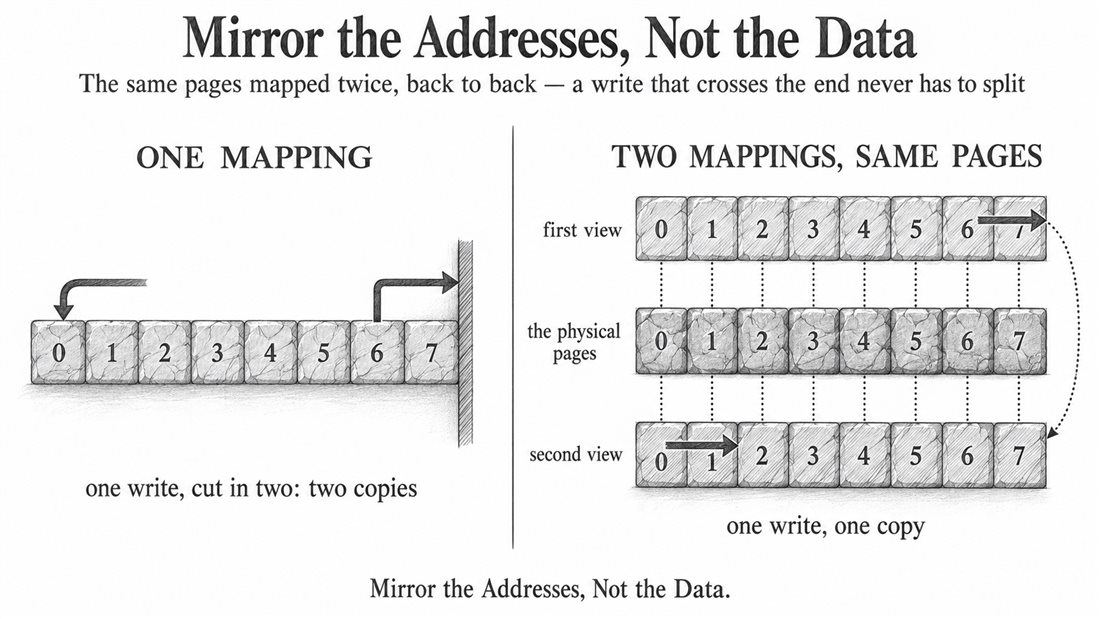
Why the file descriptor? You can’t get this from two MAP_ANONYMOUS mappings: each anonymous mapping receives its own fresh, independent pages, and there is nothing for a second mapping to point at. To make two virtual ranges share pages you need a named object both can refer to — an fd here, or a System V shared-memory segment, which plays the same role.
Everything happens at construction. The reservation, the descriptor and both mappings are set up once; after that, every enqueue and dequeue is an ordinary memory access with no system call. It’s the same move as post #3 — nothing happens for the first time on the hot path — and the pages deserve the same treatment: pre-fault them and lock them.
What it costs, and when it doesn’t apply. N must be a multiple of the page size; a failure halfway through has to unwind cleanly (munmap, close); and the second view adds page-table entries and TLB pressure. And notice what the queue from 1.1 doesn’t need it for: with fixed-size slots, an element never straddles the end, so single-element writes never wrap mid-copy. The mirror pays off for byte streams, variable-length records, and bulk reads or writes of several elements at once — where the copy itself dominates and crossing the end is common.
3. A Logger Built on the Queue
3.1 A Queue With a Reader Who Can Afford to Be Slow
Logging is the classic customer for this queue. The hot path wants to record something; the expensive parts — formatting, file I/O, the write syscall — should happen somewhere nobody is waiting. So the hot thread only fills a queue slot, and a dedicated background thread drains it.
The queue’s slots have a fixed size, so what goes into one has to be a tagged union — a type tag plus room for the biggest thing you might log:
enum class Tag : uint8_t { Char, Int, Long, Double, Text /* … */ };

struct LogElement {
  Tag tag;
  union {
    char c;  int i;  long l;  double d;  /* … the other numeric types … */
    char s[256];                          // the member that sets the price of every slot
  } u;
};   // 264 bytes on x86-64: the tag pads out to 8, then the 256-byte member
That char s[256] sets the size of every slot: an element holding a single char still occupies 264 bytes. A queue of 8 million of them is about 2 GiB — a deliberately large buffer, because the slow reader is going to fall behind during bursts.
The reader side is a loop that drains what’s there, flushes the file, and sleeps:
while (running_) {
  while (LogElement* e = queue_.try_peek()) {
    write_to_file(*e);                  // switch on e->tag
    queue_.release();
  }
  file_.flush();
  std::this_thread::sleep_for(std::chrono::milliseconds(10));
}
The 10 ms sleep is a choice, not a requirement: this thread isn’t latency-critical, so giving its core back beats spinning — at the price of log lines reaching the file up to ~10 ms late and a queue that has to absorb everything produced in that window. Two structural rules fall out of SPSC. One logger instance serves exactly one producing thread — a second producer would break the one-writer-per-counter contract, so give each thread its own logger or its own queue. And shutdown order matters: wait until the queue is drained, then stop the reader thread, then close the file. Stop the reader first and whatever was still queued is silently lost.
3.2 Thirty Slots for One Log Line
Here is a natural way to write the producer side: walk the format string, pushing each literal character as its own element and each % placeholder as a value element.
template <typename T, typename... Rest>
void log(const char* fmt, const T& value, const Rest&... rest) {
  for (; *fmt; ++fmt) {
    if (*fmt == '%') { push(value); log(fmt + 1, rest...); return; }
    push(*fmt);                                  // one character = one 264-byte slot
  }
}
void log(const char* fmt) { for (; *fmt; ++fmt) push(*fmt); }   // no arguments left
Count what log("Order Executed, id=%, price=%\n", id, price) does: 19 characters of Order Executed, id=, one integer, 8 characters of , price=, one double, one newline — 30 pushes, each a 264-byte element. That is 7,920 bytes, about 124 cache lines, written to record roughly 40 bytes of actual content.
Figure: both rows record the same log line. Nothing about the queue, the memory orders or the reader changed between them — only the unit of work per call did. Thirty publishes became five.
The cost shows up three ways:
- The hot path pays per slot. Thirty copies and thirty release stores per log call — and if the queue also maintains a shared element counter (1.2), thirty contended read-modify-writes on the line the consumer is fighting over.
- It evicts the hot path’s own data. 7.7 KiB per call is a sizeable fraction of a typical 32–48 KB L1 data cache; a logging call that dirties a sixth to a quarter of L1 isn’t free for the code that runs right after it.
- The buffer is smaller than it looks. 8 million slots at 30 slots per log line is room for about 280,000 log lines, not 8 million. A slow reader overflows it sooner, and “the queue is so big it never fills” loses most of its margin.
The fix that changes nothing else: push text runs. Instead of one slot per character, collect the literal text between placeholders and push it as a single Text element — at most 255 characters per slot, longer runs split across several. The example drops from 30 pushes to 5 (three text runs, two values) and from 7.7 KiB to about 1.3 KiB. Only the producer-side log() changes; the reader already knows how to write a text slot.
LogElement* claim() {                       // the policy point: what happens when the queue is full?
  LogElement* s;
  while ((s = queue_.try_claim()) == nullptr) { /* spin here — or count a drop and abandon the record */ }
  return s;
}

void push_text(const char* p, size_t n) {
  while (n > 0) {
    const size_t k = std::min<size_t>(n, 255);         // leave room for the terminating NUL
    LogElement* slot = claim();
    slot->tag = Tag::Text;
    std::memcpy(slot->u.s, p, k);
    slot->u.s[k] = '\0';
    queue_.publish();
    p += k;  n -= k;
  }
}

template <typename T, typename... Rest>
void log(const char* fmt, const T& value, const Rest&... rest) {
  const char* run = fmt;                                // start of the current text run
  for (; *fmt; ++fmt) {
    if (*fmt == '%') {
      push_text(run, static_cast<size_t>(fmt - run));   // everything before the placeholder, in one go
      push(value);
      log(fmt + 1, rest...);
      return;
    }
  }
}
void log(const char* fmt) { push_text(fmt, std::strlen(fmt)); }
That’s a sketch: %% escapes and argument-count errors are left out.
Two bigger changes, and where each one stops working.
Push a pointer to the format string. A string literal has static storage duration and can’t be modified, so its address is valid for the whole run: the hot path can queue an 8-byte pointer plus the argument values, and the reader does the formatting. That changes the protocol, not just log(). The reader now has to parse the format string and fetch the right number of argument slots — and because the queue publishes one slot at a time, it can observe a record whose pointer has arrived but whose arguments haven’t. You need to reserve several slots and publish them together, or move to variable-length records.
The trick works only because the pointee outlives the reader and never changes. Arguments don’t have that property:
void on_fill(const Fill& f) {
  std::string sym = f.symbol();
  logger.log("symbol=%\n", sym);     // suppose only sym's character pointer were queued…
}                                    // …sym is destroyed here; the reader arrives later, on another thread
The reader shows up after the queueing delay plus up to 10 ms of sleep — long after sym is gone, and a c_str() pointer or a stack buffer fails the same way. So arguments are copied into the queue, in the producer thread while it still owns them; only things that live for the whole run and never change can be passed by pointer.
Parse the format string at compile time. Take the previous idea to its end: everything static about a log statement — the format string, the argument types — is extracted at compile time and replaced by a small ID; at runtime only the ID and the raw argument values are recorded, and turning them into text is deferred to an offline step. That is how NanoLog works; its README reports a median of roughly 7 ns per call (its own measurement, not one I’ve reproduced). Quill takes a different route: the hot thread encodes the arguments into its queue, a backend thread does the formatting and the I/O, and the queue can be bounded or unbounded, blocking or dropping when full, with counters for how often it dropped or blocked. Across all of these fixes the pattern is the same: the cost of a log call is slots per call × cost per slot, and every real fix shrinks the first factor instead of polishing the second.
4. Lock-Free Is a Promise About Progress, Not Speed
4.1 A Ladder of Guarantees
“Lock-free” gets used loosely. There is a ladder of guarantees, and where an operation sits depends on what happens when other threads are slow, suspended, or dead:
| Guarantee | What it promises | Typical shape |
|---|---|---|
| Blocking | Nothing: if another thread is descheduled, you can be held up indefinitely | A lock; a spin-wait on another thread’s flag |
| Obstruction-free | You finish in bounded steps if everyone else pauses; under contention everyone can livelock | Mostly a stepping stone in the literature |
| Lock-free | The system always makes progress — some thread finishes in bounded steps — but a particular thread can lose forever | A CAS retry loop |
| Wait-free | Every thread finishes in a bounded number of its own steps, whatever the others do | A fixed sequence with no retry loop |
Lock-free promises that someone moves; wait-free promises that everyone does. So lock-free does not mean “never waits” — a thread stuck in a CAS loop is waiting; it’s just that its waiting is always someone else’s progress.
4.2 Where the SPSC Queue Sits
Where does the queue from 1.1 sit?
| Operation | Why | Guarantee |
|---|---|---|
try_claim + publish (producer; returns nullptr when full) | A fixed handful of loads and stores; no loop; finishing doesn’t depend on the consumer | Wait-free |
| A producer that spins until a slot frees up | A loop whose exit condition is another thread’s action | Blocking |
try_peek + release (consumer; returns nullptr when empty) | Same shape as the producer side | Wait-free |
fetch_add / fetch_sub on a shared counter | One atomic read-modify-write — on x86 a single lock xadd; on ARM without the LSE extension (before ARMv8.1) it compiles to a load-exclusive/store-exclusive retry loop | Wait-free on x86; degrades to lock-free on older ARM |
Four things follow from that.
“SPSC is wait-free” is a statement about the interface, not the data structure. The queue gets there by pushing the “full” and “empty” decisions out to the caller: the try_ operations fail and return, and the caller chooses to drop, retry or block. The spin-until-space variant bakes the third choice in — and with it, the blocking. It also explains why dropping the shared counter from 1.2 makes the claim cleaner: what’s left on the hot path is loads and stores, with no dependence on how the hardware implements atomic read-modify-writes.
“A crashed consumer can never hurt the producer” is only true while the queue has room. The ring is bounded. When it fills, the producer has exactly two options — drop the item or wait — and “wait” puts the consumer’s health back on your critical path. A bigger buffer moves the cliff further away; it doesn’t remove it. That’s why mature logging libraries expose the choice as configuration (Quill lets you pick queues that block or drop when full, and reports how often each happened), and why the number of slots each log call consumes in 3.2 is a reliability question, not just a speed one.
Finite steps are not finite time. Wait-free bounds the number of steps you execute, no matter what the others do. It says nothing about the OS preempting you in the middle of them, a page fault, or a cache miss. Predictable latency is three layers stacked: the algorithm (operations that don’t depend on other threads), the operating system (pinning, isolation, real-time priority — post #1), and memory and hardware (locked, pre-faulted pages — post #3; cache-line hygiene — post #2; no system calls on the hot path). Wait-free stops other threads from holding you up; the other two layers stop you from being held up.
And wait-free is not automatically faster. With little contention, a plain CAS-loop version usually succeeds on the first attempt and does less work than a construction carrying the machinery to guarantee a bound. What wait-free buys is the upper bound — worth having when the target is the tail (P99.9), not the mean. A multi-producer queue that claims slots with CAS is the textbook lock-free-but-not-wait-free shape, and often the right one.
5. Micro-Batching: The Backlog Picks the Batch Size
5.1 Take What’s There, Never Wait to Fill
Batching amortizes per-message overhead — one wake-up, one downstream call for many messages — but every message that waits for a batch to fill pays for it in latency. A fixed batch size is wrong in both directions: too small under load, too slow when idle. The way out is to let the backlog choose:
| Backlog | Mode | Batch size |
|---|---|---|
| ≤ 10 | Not busy — optimize latency | 1 |
| ≤ 100 | Moderate | 100 |
| > 100 | Already behind — optimize throughput | 1000 |
size_t pick_batch(size_t backlog) {
  if (backlog <= 10)  return 1;
  if (backlog <= 100) return 100;
  return 1000;
}

size_t drain(Queue& q, std::vector<Msg>& out, size_t target) {
  size_t n = 0;
  Msg m;
  while (n < target && q.try_pop(m)) { out.push_back(m); ++n; }   // never waits for a full batch
  return n;
}
The important line is the loop condition: drain takes at most target messages and stops the moment the queue is empty. It never waits for a batch to fill. So when there’s no backlog, the batch is a single message and adds no latency at all; batches only grow when messages have already piled up — when they were going to wait anyway. The batch size follows the load without a timer.
5.2 Where the Backlog Number Comes From
The tempting answer is a counter: fetch_add(1) on enqueue, fetch_sub(batch_size) after each batch. That’s the contended line from 1.2 again — and it isn’t even exact. The counter is bumped after the enqueue, so a fast consumer can drain a message and decrement before the producer has counted it; with an unsigned counter the value wraps to an enormous number for a moment, and a read that lands in that window sees a huge backlog. Ask the queue instead. That has a cost, and it shows up in the type system: a generic batcher that only knows enqueue and dequeue can’t see the queue’s counters, so the queue type has to promise an O(1) approximate size:
template <typename Q, typename Msg>
concept BatchSource = requires(Q q, Msg& m) {
  { q.try_pop(m) }   -> std::convertible_to<bool>;
  { q.size_approx() } -> std::convertible_to<size_t>;
};
An approximate snapshot is enough — it only selects one of three tiers, and being off by a few messages changes nothing. Not counting yourself isn’t free; you pay for it with a stronger requirement on the queue.
In Practice
The counter that made two cores fight in 1.2 matches the B7 Shared Statistics Counter card below: what perf shows, how to fix it, how to verify the fix.
- Signal:
lock add/inc/xaddon the hot path, with no cmpxchg retry loop; c2c shows the same offset written by many CPUs (true sharing); inconspicuous on 1 core, it shows up only with several.- Cause: every atomic add must own the cache line exclusively, so the line travels between cores, each time at close to memory latency (about 100–300 ns). Relaxed memory order does not help; the hardware still needs exclusive ownership.
- Fix, one of three in order of preference:
- increments inside one function’s loop, at no more than 2 hot spots: accumulate in a local variable and add it once with a relaxed atomic per batch or at function exit. A pure compute loop adds once at the end.
- increments spread over many places: bucket by CPU number. Use an array of 64-byte-aligned stats structs indexed by
sched_getcpu() & 63; put all counters in the same struct sosched_getcpuis called once; sum the buckets when reading.- a shared library that cannot easily own a global array: use
__threadthread-local variables, flushed to the global on thread exit or periodically.- Still contended after bucketing: check whether flushes are too frequent, for example once per request, and lengthen the interval.
- Verify: the total is only approximate at any moment, so confirm the business can live with that;
lockinstructions disappear from the hot path; HITM on that line drops in c2c.- Mechanism: where the cost of a write comes from is in the MESI special, Part 5; sharding a counter per thread and merging afterwards is in the MESI special, Part 6; the counter both cores write is in #4 1.2.